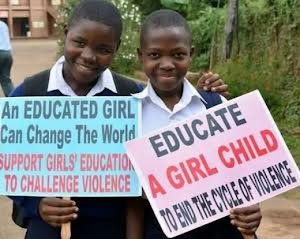
Yes, the rights and privileges of a girl-child are restricted in terms of so many benefits like education, politics, freedom…However, high percentage of them are exposed to numerous dangers in the society. Some believe education isn’t meant for them. Is it as a result of the old doctrine that is still practiced even to the 21st century?
Let me go down to memory lane. When the colonial masters introduced the education pattern, our forefathers believe educating a girl-child is a waste of money and resources. However, some ‘sees’ it as a taboo or better still, an abomination because they have a strong notion that she will end up in a man’s abode and spend all her life in the kitchen. Funny enough, some cultures, up till now, believe the old doctrine. Should I call this ignorance or a culture that should be eradicated?Looking at the political aspect,the society has turned politics to ‘a-man-job’ restricting females. Thanks to the new generation that are making great changes.
Join me, Let’s see the pain a girl-child is afflicted with in the society.
WHO IS A GIRL-CHILD?
A girl-child is a biological female offspring from birth to the age of eighteen(18) years. This is the age before one becomes a young adult. This period covers the crèche, nursery or early childhood (0 – 5years), primary (6 – 12years) During these period, the child is under the care of an adult who may be her parents or guidance and ‘older sibling(s)’ it is made up of infancy, childhood, early and late stage of adolescence. During these period, the child is malleable. she tends to develop her personality and character,she is very dependent on others;these on whom she models her behaviour through observation, repetition and imitation. Her physical, mental, social, spiritual and emotional developments start and progress to get to the peak at the young adult stage.
However, back then in history, even up till today in some cultures, a girl-child is seen as nothing. Our forefathers wanted a son and not a daughter which contributes to the rate at which polygamous marriage increased in the past. Then, men married more than one wife just to ‘produce’ a male child. Some women are called names because of their inability to produce a male child.Tell me, are they God?
The society has placed so much pain on a girl-child which includes:
EDUCATION:
What Is Education?
Education is a process of providing information to an inexperienced person to help him/her develop physically, mentally, socially, spiritually, politically and economically.
It is also seen as the process through which an individual is made functional members of the society. It is a process which an individual acquire knowledge and realises his/her potentialities to be useful for his/her self and others.
Education is a fundamental human right which should be enjoyed irrespective of the gender. Women in Nigeria have various challenges in obtaining equal education in all forms of formal education. Education in a basic human right and has been recognized as such since the 1948 adoption of the universal declaration on human right whereas, rapid socioeconomic development of a nation has been observed to depend on the calibre of women and their education in that country. There are lot of human right instruments that provide for education as a fundamental right (1948)
However, the importance of education in the life ofa girl-child cannot be overemphasized.Many girls today do not have adequate education. In some region where girls are at the range of 12-14years, the elders in the community presumes that ‘she is ripe for marriage’ and their words are LAW; so, tell me what worth are her words when the elders have spoken? Thus, depriving her of her freedom of expression as embedded in the constitution of the Federal Republic of Nigeria 1999 section 39(1).
The nature traditional philosophy is that a woman’s place is in her husband kitchen and her primary role centres on her home. This belief has kept many girls away from education. When a girl is given out at a very tender age to a man old enough to be her grandfather, her right as a woman has been abused as most Nigerian would say ‘she don marry her grandpa.’ Also, her right of being educated has been deprived and would be doomed to be an illiterate forever if her husband does not give her the opportunity to be educated after the union. Female education serves as an investment that will help facilitate the achievement of family planning objectives and production of heathier children.
Educating a girl-child translates to better health of the future generation. Also, Education bestows on women (is) a disposition of a lifelong acquisition of knowledge, values, attitudes, competence and skills. Reduction in child’s mobility and mortality thus triggering a snowball effect of achieving all other sustainable development goals in a viable manner. The girl-child needs to be educated to acquire knowledge and skills needed to advance her social status for social interaction and self-improvement. Investing in a girl-child education is vital to driving human capital development in the country. Think about great professionals like Dr(Mrs) Eniola Fadayomi, Prof. Bolanle Awe, Dr Ngozi Okonjo Iweala, Dr Obiageli Ezekwesi, Mrs Omobola Johnson, Dr Sarah Alade and many more are products of great investments in girl-child education.
CHILD ABUSE:
The Federal Child Abuse Prevention and Treatment Act (CAPTA) (42 U.S.C.A. § 5106g), as amended by the CAPTA Reauthorization Act of 2010, defines child abuse and neglect as, at minimum:
“Any recent act or failure to act on the part of a parent or caretaker which results in death, serious physical or emotional harm, sexual abuse or exploitation”; or
“An act or failure to act which presents an imminent risk of serious harm.”
child abuse can be seen in two forms in this article which are:
EARLY MARRIAGE.
This is another danger a girl-child is exposed to in the society.
Under the Child Rights Act 2003, the minimum legal age of marriage is 18 years. Also, in African Children’s charter under section 21(2) which states:
‘child marriage and the betrothal of girls and boys shall be prohibited and effective action, including legislation, shall be taken to specify the minimum age of marriage to be 18 years and make registration of all marriages in an official registry compulsory.’
However, the Child Rights Act prohibits both the marriage of those considered to the children and betrothal of children. In relations to child marriages part iii section 21 states:
‘no person under the age of 18 years is capable of contracting a valid marriage, and accordingly a marriage so contracted is null and void and of no effect whatsoever.’
Under the marriage act 1990, the minimum legal age of marriage is 21years for girls, although they are able to marry before the age with the consent of a parent or guardian.
Early marriage is mostly practiced in the northern part of Nigeria. In the northern part of Nigeria, 48% of hausa-fulani are married by age 15 and 78% are married off at the age of 18. This appalling statistics led Elizabeth to describe the life of a girl-child in northern Nigeria as ‘pathetic.’ However, to buttress her assertion, she maintained that while the ideal marriage of women, although it varies between 20 and 26 years old. In the northern part, where children who have started menstruating are considered mature for marriage and the case of menstruation varies as a girl of 12years can be given out of marriage based on the fact that she has started menstruating.
In the precolonial era, rigid ideas on gender were impulse on African mind. The women’s role was mainly for sexual and commercial labour, satisfying the sexual needs of her man, working on the field, tending the babies and preparing food. How can a girl who is not up to 18 years be able to do all these and look after her so called family?
A girl given out at a tender age is placed at a very high risk. Do you want to tell me a 13years old is ready to be a mother? What does she know about family life? Obviously the skills that she should have learnt to be a better mother isn’t there.
Nigeria has signed and ratified international and instrument which regulate the rights of children. Nigeria ratified the Convention of the Right of a Child (CRC) on 16th of April 1991, and the African charter on the right and welfare of the child (African Children’s Charter) on 12thJuly 2001. Additionally, Nigeria took steps to domesticate both instrument in the form of the Child Right Act (CRA) but despite these, early marriage is still seen as a legal act in some communities.
An important clause which can be invoked against child marriage is section 24(3) of CRC, which states:
‘state parties shall take all effective and appropriate measures with a view to abolishing traditional practices prejudicial to the health of children’
The provision is perhaps the most relevant clause against child marriage, given that the hausa-fulani practice of child marriage is part of their tradition as this traditional practice is detrimental to the health of the girl.
Also, under section 21(18) of the African children’s charter, states parties are urged to
‘…take all appropriate measures to eliminates harmful social and cultural practices affecting the welfare, dignity, normal growth and development of the child in particular:
Those customs and practices prejudicial to the health or life of the child; and
Those customs and practices discriminatory to the child on the ground of sex or other status.
Early marriage should be outlawed, and parents should be educated about the benefits of later marriage. a national children’s commission should be set up for defending the rights of girl child in an educational, social, cultural, political and economic context. The commission should maintain statistics of a child survival and other socioeconomic factors. Parent have an important role to fulfil in helping female children achieving the basic necessities of survival, development and in learning about the fundamental rights of child development and care. Also, teachers have an important role to play in teaching about early marriage.
(2) Rape
Rape can be define using the following references:
Under the Criminal Code of Nigeria (Section 357 & 358), Rape is defined as
‘having unlawful carnal knowledge of a woman or girl, without her consent, or with her consent if the consent is obtained by force or by means of threats or intimidation of any kind, or by fear of harm, or by means of false act, or, in case of a married woman, be personating her husband.” This offence is punishable by imprisonment for life, with or without caning.’
Under the Penal Code of Nigeria (Section 282),
“A man is said to commit rape when he has sexual intercourse with a woman in any of the following circumstance: against her will; without her consent; with her consent, when the consent is obtained by putting her in fear of death or of hurt.”
Under the Criminal Laws of Lagos State (Section 258) which states,
“Any man who has unlawful sexual intercourse with a woman or girl without her consent, is guilty of the offence of rape”
Under the Violence Against Persons Prohibition Act (Section 1)
“A person commits the offence of rape if he or she intentionally penetrates the vagina, anus or mouth of another person with any other part of his/her body or anything else without consent, or the consent is obtained by force”
Rape and sexual assault are serious crimes against the dignity and sexual autonomy of the next person. Every individual has the right and choice to make informed decisions about their sexual conduct and also to respect the rights and dignity of others. We can see from the legislations above that consent is a predominant factor when it comes to offences of rape and sexual assault.
We can also note that the VAPPA (Violence Against Persons Prohibition Act) is quite progressive as it makes provisions for both male and female sexual offenders. It also takes into consideration in another section the rape of a person by a group of people which is the first of its kind in Nigerian laws.
With regards to the prosecution and conviction of sexual offenders, it is unbelievable that despite the prevalence of rape and sexual violence in our society, there have been only 18 reported convictions in Nigeria till date.It goes to show that a lot of people are ignorant of the law, it shows that rape has become normalized to the point that survivors do not feel the need to report. It also shows that there is little or no belief in the justice system.
On November 17th 2014, a four-year-old girl was ganged-raped by her school staff. The gruesome incident goes to highlight the suffering of girl child. According to recent report by a child right NGO, sexual abuse against the child surpasses that against the male one, a fact which relegate the former as the more socially disadvantaged member in the society.
In order for us to have an increase in the rate of prosecution and convictions of sexual offenders there needs to be an increase in advocacy. Survivors especially the females need to be aware of their rights as citizens, they need to know that justice can be achieved and that the perpetrator can be punished for this crime. It is important to note that rape can happen to anyone but it is never the fault of the survivor. It does not matter what she was wearing, where she was or what she was doing – it is always the fault of the perpetrator/rapist as rape is a conscious decision. I know a girl raped at the age of ten when she was still a kid; tell me what might have attracted the perpetrator to her if not for the devilish desire.
A girl child is exposed to this life especially those from broken homes. When a girl is raped, it can lead to so many effects which can be sexually transmitted diseases like HIV/aids, syphilis, gonorrhoea etc. it can also lead to unwanted pregnancies which can cause emotional trauma or worse to the victim.
(c) Child trafficking
Trafficking in children is a form of human trafficking and is define by The United Nations as the recruitment, transportation, transfer, harbouring and/or receipt kidnapping a child for the purpose of slavery, forced labour and exploitation for the purpose of prostitution, sexual exploitation, forced labour or services, slavery servitude or removal of organ which goes against the law.
Section 34(1) of the federal republic of Nigeria 1999 states:
Every individual is entitled to respect for the dignity of his person, and accordingly
No person shall be subject to torture or to inhuman or degrading treatment:
No person shall be held in slavery or servitude; and
No person shall be required to perform forced or compulsory labour.
Human trafficking has been described as a modern day form of slavery. Trafficking involves the transport or trade of people within and across boarders for the purpose of forcing them into slavery conditions.
The effect and consequences of child trafficking in Nigeria is still having its toll in children especially the girl-child who are indeed the leader of their family and the society at large despite the domestic laws enacted by the government to fight the practice. However, the causes of child trafficking are nothing but poverty, ignorance, illiteracy, unemployment, corruption, greed, peer group pressure, broken homes, family size and many more. These factors make children to migrate elsewhere for better opportunities. It usually drives people to leave a region in search for better life elsewhere. The destination of the migrant is usually at bigger cities. Sometimes the economic situation is such that most parents are unable to care and properly feed their family; in the process, some fall a victim to the bogus promises of a good time abroad with the prospect of earning foreign exchange that will be converted into tons of naira in Nigeria and because of that, some have sold their child especially their girl-child to unknown slavery or prostitution. Although Nigeria has enormous human and natural resources as well as the largest oil producer in Africa and the eleventh largest in the world, It is related as one of the poorest country in the world with GDP per capital of about US$150 million with about two-third of the population living in rural areas without basic amenities such as electricity, hospital, school, poor drinking water etc. and earning less than $1 per day so due to this, they subject their children especially the girl child to various forms of labour including trafficking for economic gain.
Girl trafficking is one of the dangerous illegal practice which should be totally eradicated.
CONCLUSION
The society have placed so many plight on the girl-child which some are explained in the above article. The girl-child faced so many dangers in the society which ranges from the family and down to the society; these have make them vulnerable to Poor nutrition, vulnerability to diseases, poor physical and mental development, inferiority complex, fear, emotional trauma just to mention but few. However, these hazards should be looked into and more governmental forces should be empowered to fight against such act. Let’s note that Investing in girl’s education transforms the communities, countries and the entire world; Girls who are educated are more likely to (live) healthy and productive lives. Early marriage is never a way out and obviously a culture that should be eradicated. Rape, ‘the culture of today,’ should be stopped! Beliefs must be changed about the value of girl-child education. There should be elimination of gender bias!
REFERENCE
o Anyanwu; and Scand J Altern., ‘the girl-child: problems and survival in the Nigeria context’ March-June 1995 available at accessed on 9th August, 2020.
Plight Of The Girl Child November 19, 2014 available attribune.com.pk accessed on 9th August,2020.
Criminal Code
Kemi DaSilva-Ibru., ‘WARIF Women at Risk International Foundation’ September 22, 2019 available at accessed on 9th August, 2020.
danchurchaid.org accessed on 9thAugust, 2020.
the value of girl-child education in Nigeria, Monday august 13, 2018 available at http://www.proshareng.com accessed on 17th July 2020
Mercy Dominic., ‘Girl Child Education: A Central Key To The Drive For Nigeria’s Development’ February 10, 2019 available athttp://www.proshareng.comaccessed on July 17 2020.
Constitution of The Federal Republic of Nigeria 1999
Abdulrahman and Oladipo A. R., ‘Trafficking in Nigeria: A Hidden Health and Social Problem in Nigeria’ (2010) international journal of sociology and anthropology vol. 2
‘’improving Women’s Education in Nigeria’’ asec-sldi.org accessed on 11 August 2020
‘Universal Declaration Of Human Rights’ available atamnesty.org accessed on 11 Aug. 2020
unicef.org accessed on 11th August, 2020.
‘Definitions of Child Abuse and Neglect in Federal law’ available at childwelfare.gov accessed 20th August, 2020.
girlsnotbrides.org accessed on August 20, 2020
Violence Against Persons Probation Act (VAPPA), 2015
Criminal Code of Lagos State
Penal Code of Nigeria
Criminal Code of Nigeria, 1990
African Children’s Charter
Child Right Act(CRC) 2003
Convention of the Right of a Child (CRC) 1989
Oluwaleye Adedoyin Grace writes from Faculty of Law, Ahmadu Bello University, Zaria
 Site Title